

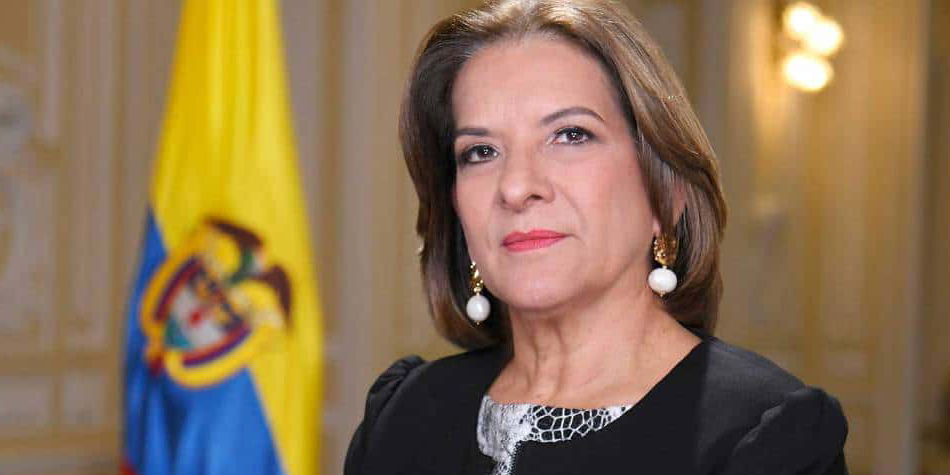
Francisco Barbosa, Carlos Camargo, and Margarita Cabello come from different academic and professional worlds, and even separate ideological currents. However, the three have something in common: they became unbeatable among their peers in the shortlists for the positions they were nominated for. With the recent announcement by the Liberal Party to back Cabello, the lawyer from Barranquilla is the virtual Attorney General of the Nation (the first in history) with the strong support of the government and independent blocs (and an occasional opponent).
According to the counts, the Democratic Center, the Conservatives, the Party of the U (excluding Roy Barreras), Radical Change, and the Liberals, as well as the Christian blocs MIRA and Colombia Justa y Libres, would amass over 70 votes, which are sufficient for Margarita Cabello to be elected. Just a few days ago, Carlos Camargo had won overwhelmingly with 140 votes in the plenary session of the House of Representatives, which elected him as Ombudsman. An additional detail emerges from this election: Camargo was nominated by the president on August 6, and his election occurred one week later, on August 14. Cabello had not resigned from the ministry, and her election was already foreseeable due to the political influence of her position and her relationship with Congress.
In light of this panorama, some questions and criticisms arise that we would like to briefly address. In principle, what is the role of the other two nominees for the position and the processes that take place in the high courts to elect them. Former deputy prosecutor Juan Carlos Cortés and former magistrate Wilson Ruíz participated in complex selection processes that began with broad lists of applicants before the Council of State and the Supreme Court of Justice, respectively.
Your situation is not the most comfortable because, while it's true that aspiring to lead the Public Prosecutor's Office is of great value to your resumes, you've had to settle for seeing political parties and their presidents or directors loudly announce who they will vote for on election day. Now, this doesn't mean that candidates nominated by the high courts are always “stone guests” who have no influence on the election. In fact, the outgoing prosecutor, Fernando Carrillo, and Alejandro Ordóñez, in his first election, were nominated by the Council of State.
However, the problem lies in the fact that the parties approach this process with the calculation characteristic of a popular election. Thus, presidents and their caucuses adhere to one candidacy or another after informal meetings, trivializing the debate about the academic and professional qualifications of the nominees. In this process, the sizable payroll of this autonomous body becomes an incentive for the political groups to jump on the bandwagon of the winner. Support for the candidate who is ultimately chosen can be a guarantee for securing bureaucratic quotas within the entity.
The Attorney General's Office of the Nation has, among others, the following functions: to be the highest body of the Public Ministry (guarantor of rights); to monitor and warn about the actions of public officials (preventive function); to intervene and provide opinions before the Administrative Litigation, Constitutional, and at the instances of the criminal, military criminal, civil, environmental and agrarian, family, and labor jurisdictions (intervention function); and to conduct and rule on disciplinary investigations against public servants (disciplinary function).
To that extent, the person at the head of the agency has numerous delegates who are responsible for everything from investigating irregularities in the hiring of other entities, as in the case being followed regarding the hirings of the National Registry, to prosecuting public officials in disciplinary matters, such as the process against Senator Eduardo Pulgar Daza (Party of the U) for an alleged attempt to bribe a judge with 200 million pesos.
From the foregoing, it is reasonable to infer that the Prosecutor General should have absolute independence from members of the Senate in order to properly perform his duties. This implies that the election cannot be the product of a quid pro quo. Although the upper house elects him, it does so within the framework of checks and balances. The president and two high courts participate as nominators in the process. The underlying logic is that the three branches of public power, over which the Prosecutor General has jurisdiction, are included in the process.
Now, the exchange can not only occur between the Prosecutor and members of the Senate, but it can also include other branches. For example, the reelection of Alejandro Ordóñez was annulled by the Council of State because the Prosecutor had appointed relatives of judges of the Supreme Court of Justice to positions within the entity.
In conclusion, the election of the Attorney General of the Nation should be undertaken by the three branches of public power as a process that demands the highest standards. Not only because of the functions that the position entails, which are of the utmost importance, but also because the system of checks and balances requires that whoever occupies this position enjoys full independence from the other branches of power, and can exercise their competencies.
Beyond the analysis above, we believe Dr. Cabello has the stature and background for the role she will perform as Attorney General. Her technical profile and career path generate credibility.
Profile of the Virtual Prosecutor
Margarita Cabello graduated from the Corporación Universitaria de la Costa and holds a specialization from the Universidad del Rosario. She has had a career in the judicial branch in Barranquilla, serving as a clerk, judge, and magistrate, and moved to the capital in 2009. At that time, she was appointed Deputy Prosecutor for Disciplinary Oversight by Alejandro Ordóñez. In fact, around the same time, former President Álvaro Uribe included her in the shortlist for Prosecutor General of the Nation.
In 2012, Cabello was elected by the full bench of the Supreme Court of Justice to join the civil chamber of said corporation. There she gained her greatest notoriety, reaching the presidency of the Court in 2016 and being nominated by President Duque to be ad hoc Attorney General in the Odebrecht investigations. Finally, she took office as Minister of Justice, replacing Gloria María Borrero.