

[container section_title='Container' fullwidth='no' bgtransparency='0' top='20' bottom='20' innerbottomshadowsize='0' bordertop='0' borderbottom='0' collapse='false'][column type='12' last='1'][/column][/container]
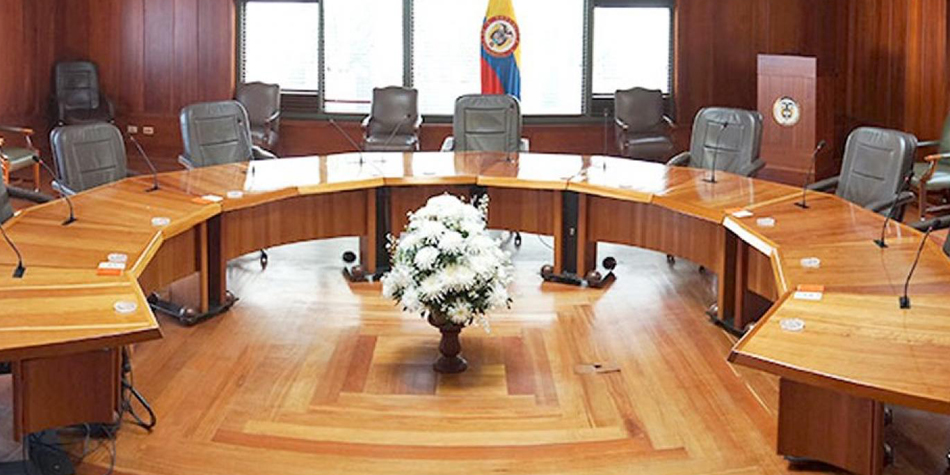
Two seats on the Constitutional Court are nearing vacancy. Positions held by conservative jurists are available for the Council of State and President Iván Duque to propose the slates they deem appropriate to replace Justice Luis Guillermo Guerrero – whose term ends on September 4th – and Carlos Bernal Pulido – who abruptly resigned due to an academic offer at the University of Dayton (Ohio, United States). Bernal arrived with Juan Carlos Henao just over three years ago, leaving him with five more years in his term.
Last week, the Council of State finalized its shortlist. Jorge Enrique Ibáñez Najar, Natalia Ángel Cabo, and Marino Henao Ospina are the candidates to occupy a position in the high constitutional court. As such, Ángel has a high probability of being elected with the support of parties like the Liberal Party, Cambio Radical, and the opposition. She is an openly liberal lawyer, a graduate of the Universidad de Los Andes, and holds a Master's degree in Constitutional Law from Harvard. She has worked on issues concerning the rights of people with disabilities and the right to the free development of personality. She was a protégé of former magistrate Carlos Gaviria, with whom she worked at the Court and in the Senate, bringing highly controversial issues to the table years ago such as the minimum dosage for drugs, abortion, and same-sex marriage.
Jorge Enrique Ibáñez is another “heavyweight” of law and could put up a fight for the position, if he receives the support of the government caucuses in the Senate. This lawyer, a specialist in Constitutional Law from Universidad Javeriana, was an advisor to the 1991 Constituent Assembly, which means he knows the Constitution in depth. He holds a master's and a doctorate in Public International Law from Universidad Alfonso X El Sabio. He has served as a substitute judge for the Administrative Tribunal of Cundinamarca and the Council of State. But, without a doubt, his role as arbitrator between the Colombian state and the Ruta del Sol concessionaire earned him great recognition in recent years.
In light of this scenario, the scales seem to be tipping toward progressive orientations. Before the departure of these two justices, the nine seats on the Constitutional Court maintained an ideological balance between liberals, progressives, and conservatives, depending on whether the issues were moral, civil, or economic.
However, the Court's ideological distribution warrants an approach from various fronts. For example, outgoing Justice Luis Guillermo Guerrero has advocated for limiting same-sex marriage and adoption, but made a decision against the Conservative Party regarding adoption by lesbian mothers and in the Statutory Law on the plebiscite. On the other hand, Justice Gloria Stella Díaz is a defender of gender equality, but on issues such as prior consultation, she takes a more restrictive and economistic stance (for further detail, see Analysis of the Razón Pública portal).
Given this situation, it is now up to the government, in addition to the shortlist for Prosecutor and Fiscal, to present a proposal of candidates to replace Magistrate Bernal. For this reason, in order to maintain balance and taking into account the profile of the President and his party, there is no doubt that the candidates will be of that caliber.
The following names are being considered for the replacement in the Constitutional Court's seat:
Rafael Nieto Loaiza: Right-wing, conservative man. Lawyer and politician. Deputy Minister of the Interior and Justice between 2003 and 2004. Presidential pre-candidate for the Democratic Center party when Iván Duque was elected. Critic of the peace accords with the FARC. What could prevent his candidacy in the national government's shortlist is his strong opposition to President Duque and his leadership style.
Abelardo De la EspriellaRight-wing man. Doctor Honoris Causa in Law, Master of Laws, specialist in Criminal Law and specialist in Administrative Law. Advisor to paramilitary groups in demobilization during the Álvaro Uribe administration. Critic of left-wing sympathizers. He has been lawyer for the current senator Uribe in several cases. Very close to President Duque.
María Carmelina Londoño: Conservative. Professor at the University of La Sabana in the area of International Law. Experienced in international and constitutional law issues. Her chances seem slim due to having a more academic profile than a political one, with the Senate being the stage where she must prove herself if she wants to become a magistrate.
Álvaro Motta: Conservative. Current Ambassador of Colombia to the Netherlands. He was a substitute judge for the Constitutional Court, the Council of State, and the Supreme Court of Justice. He was also part of the National Accreditation Council from 2016 to 2019. At Pontifical Javeriana University, he was the director of the specialization in Substantive and Contentious Constitutional Law and the director of the Master's degree in Constitutional Law. He was previously a candidate for the Court in 2017.
Camilo Gomez: Conservative. Director of the National Agency for the Defense of the State. Lawyer from Pontifical Javeriana University. Former High Commissioner for Peace during the government of President Andrés Pastrana, thus belonging to that political party's wing.
Clara María Gonzalez: She is the legal advisor to the Presidency, a lawyer who graduated from the Universidad del Rosario. She has worked as an advisor and contractor in the public sector, particularly in the Chamber, the Senate, the Registry Office, and public services companies. In academia, she has had a career at the Universidad del Rosario and the Universidad Sergio Arboleda.
The Constitutional Court is the highest constitutional body in the country, responsible for ensuring the integrity and supremacy of the national Constitution. It is composed of nine magistrates, whose term is eight years. They are elected from slates sent by the President of the Republic, the Supreme Court of Justice, and the Council of State. The ideological balance of the Court's members is decisive in the outcome of the country's constitutional decisions.
On the Margin A tempest is being experienced within the U Party. With the departure of the previous government, Juan Manuel Santos's party was left adrift; there is no ideology to define the party nor leadership to keep them united. Aurelio Iragorri, former Minister of the Interior and Agriculture, has led this party as its president. There is an internal struggle led by Armando Benedetti and Roy Barreras, who seek to remove him from his position, arguing that his term has expired without renewal, and therefore, they claim his tenure is illegitimate. Additionally, Iragorri published a WhatsApp audio to the party's members of the Chamber of Representatives, in which he shared the content of the meeting he held with President Duque, openly requesting the position of the Ombudsman's Office for that party.
Listen to the audio here.
https://lasillavacia.com/audio-iragorri-sobre-duque-confirma-negociacion-defensoria-77732