


- The president's inaugural address
- The greeting: While it is true that the president protocolarily greets high-ranking state dignitaries (presidents of Congress, high courts, the vice president, the attorney general, among others), on this occasion, Iván Duque dedicated his second greeting to former president and senator Álvaro Uribe, the natural leader of his Democratic Center party.
- The installation Apparently, the president forgot to formally declare the 2020-2021 legislature installed, a part of the speech that seems minor but is a necessary formality. The Secretary-General, Gregorio E. Pacheco, reminded the president of the need to carry out this procedure.
- The opposition's response: Senator Aída Avella (Decentes) was in charge of exercising the right of opposition parties and movements to present their vision of the country and their observations regarding what Duque had said. The senator began by asking if the president was present at the session and also lamented the deaths resulting from the pandemic.
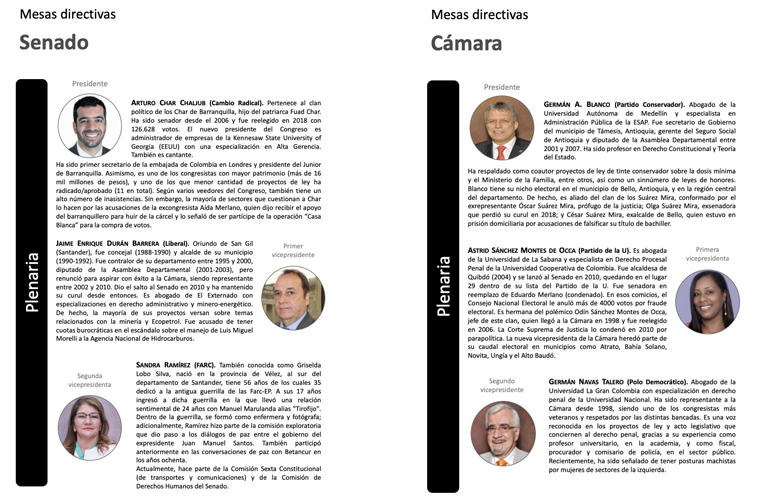
- The vice presidential change: At the last minute, the opposition bloc declined their intention to nominate Gustavo Bolívar for second vice presidency, which corresponds to them by virtue of the Opposition Statute, and in his place proposed the name of Sandra Ramírez or Criselda Lobo, one of the senators from the FARC. The Democratic Center voted blank for this nomination.
In principle, the president highlighted some of the bills approved in the last legislature, as well as the programs created and strengthened through decrees issued under the state of emergency. Among the laws mentioned are the Neonatal Screening Law and the Electronic Health Records Law. Duque also highlighted the Colombia Mayor program and the housing subsidy allocations, which he said amounted to seventy thousand. The educational programs Generación E and the School Feeding Plan (PAE) were also mentioned by the president.
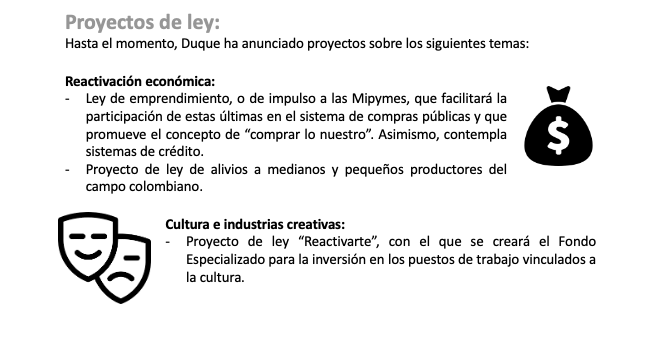
Entrepreneurship, which has been one of the president's key focuses, was broadly addressed in the speech, highlighting the simplified tax regime created under the Economic Growth Law for companies with technological, cultural, and creative added value. Duque did not forget the agricultural sector, bringing up programs such as "Coseche y venda a la fija" (Harvest and Sell for Sure) and "Agricultura por contrato" (Contract Agriculture). Regarding digital transformation, the Colombia Crea Talento Corporation and the Naranja Development Areas were mentioned. Furthermore, he highlighted some incentives for cinema, although he did not elaborate on them in depth.
Entrepreneurship, which has been one of the president's key focuses, was broadly addressed in the speech, highlighting the simplified tax regime created under the Economic Growth Law for companies with technological, cultural, and creative added value. Duque did not forget the agricultural sector, bringing up programs such as "Coseche y venda a la fija" (Harvest and Sell for Sure) and "Agricultura por contrato" (Contract Agriculture). Regarding digital transformation, the Colombia Crea Talento Corporation and the Naranja Development Areas were mentioned. Furthermore, he highlighted some incentives for cinema, although he did not elaborate on them in depth.
The Post-COVID-19 Economic Recovery During his speech, Iván Duque made ambitious announcements regarding the economic recovery, which will consist of: 1) programs and subsidies for vulnerable populations; and 2) progress on infrastructure projects and job creation.
- The unconditional cash transfer program Ingreso Solidario will be maintained until June 2021.
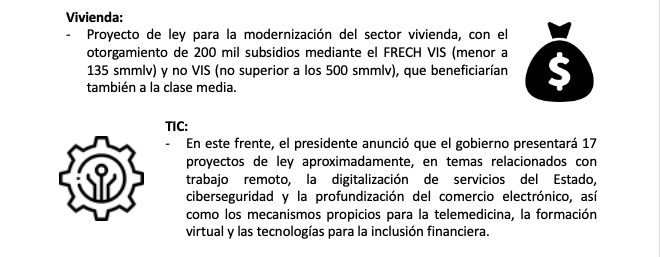
- 200,000 housing subsidies will be made available, which, according to the president, will generate 230,000 jobs and benefit the middle class (this includes VIS and non-VIS housing).
- In terms of infrastructure, the Bogotá Metro, Puerto Antioquia, the new airports in Cartagena, San Andrés, and Aerocafé, as well as the ALO SUR highway in Bogotá, will receive special government support (14 national and regional roads).
- Culture has its privileged place in this package of measures, as the president announced two trillion pesos in incentives for creative and cultural industries.
- In short, the total government investment will be 100 trillion pesos, as part of an articulation between the public and private sectors, which will generate more than one million direct and indirect jobs.
Read the full report. Here.